
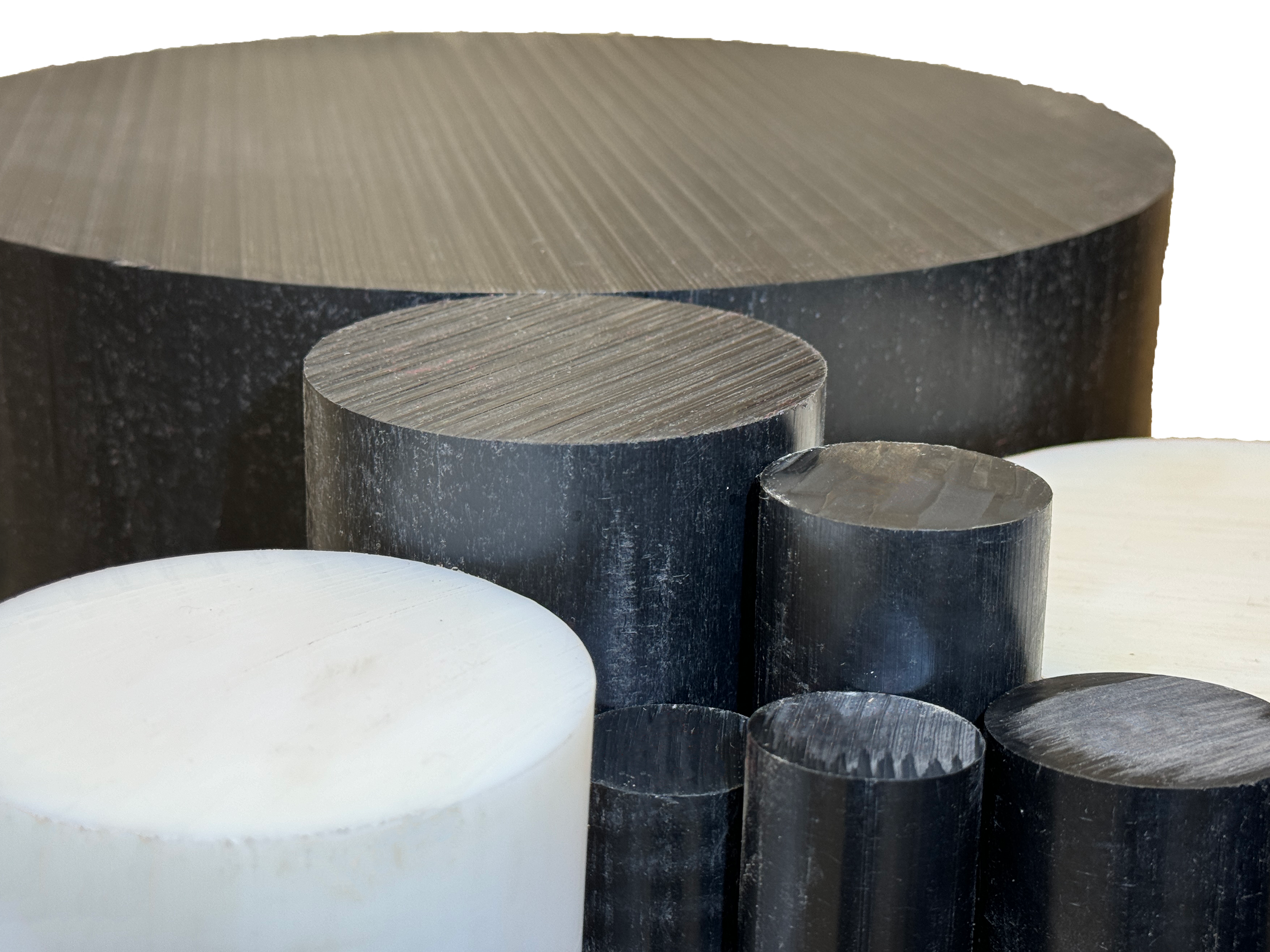
POM-C is an engineering plastic with high stiffness, good dimensional stability and low friction. The material is therefore well suited for machined components where precision, durability and stable dimensions are important.
POM-C, also known as polyacetal or acetal plastic, is used for, among other things, bushings, gears, guides, rollers and other mechanical components. The material is supplied as semi-finished products in, among other things, plates and rods and can be CNC-machined into finished components according to drawings or 3D models.
But when should you choose? POM-C rather than other technical plastic materials such as PA6 or PEHD1000?
What is POM-C?
POM-C is a thermoplastic in the polyacetal family. The C denotes the copolymer variant of POM, which is widely used as a structural plastic in industrial applications.
An important feature of POM-C is the combination of high rigidity, low friction and good dimensional stability. The material also has low moisture absorption compared to, for example, PA6.
This makes POM-C particularly interesting for machined components where geometry and tolerances must remain stable during use.
Typical applications for POM-C
POM-C used for a variety of mechanical components and machine parts.
Typical uses include:
- bushings and bearing components
- gear
- rollers and wheels
- guides and sliding parts
- distances
- valve parts
- machine components
- precision parts
- special components machined according to drawing
The material is particularly relevant where a combination of mechanical strength, low friction and good tolerances is desired.
Why is POM-C used for precision components?
One of the biggest advantages of POM-C is the good dimensional stability.
Engineering plastics are affected to varying degrees by temperature, humidity and mechanical stress. POM-C has relatively low moisture absorption and is therefore less susceptible to dimensional changes due to humidity than, for example, PA6.
This can be crucial for components with tighter tolerances, such as bushings, guides, valve parts and other machined parts where fit and function are important.
POM-C can therefore be a good alternative to both other plastic materials and metal in the right application.
POM-C or PA6 – what's the difference?
Both POM-C and PA6 are widely used for machined industrial components, but the materials have different strengths.
POM-C has low moisture absorption and very good dimensional stability. This makes the material particularly interesting for precision components and parts with relatively tight tolerances.
PA6 has good mechanical strength, toughness and wear resistance and can be well suited for, among other things, wheels, rollers, bushings and larger mechanically loaded components.
PA6 However, it absorbs more moisture than POM-C. This can affect the dimensions and must be taken into account when choosing materials.
If dimensional stability and precision are crucial, POM-C therefore often be a natural material to consider.
POM-C or PEHD1000?
The difference between POM-C and PEHD1000 becomes particularly clear when looking at stiffness and sliding properties.
POM-C is significantly stiffer and better suited to precise mechanical components.
PEHD1000 is in turn particularly interesting for applications where low friction, high wear resistance, impact resistance and very low water absorption is important. Typical examples are slide rails, wear strips and guides.
A precisely machined liner may therefore be well suited in POM-C, while a strong sliding rail may be better suited in PEHD1000.
CNC machining of POM-C
POM-C has good machining properties and can be milled, turned, drilled and machined into complex components.
The material's stiffness and dimensional stability make it well suited for CNC machining, even when the component has details or tolerances that are more difficult to achieve in softer plastic materials.
As with all machining of technical plastics, tools, cutting data, heat generation and clamping must be adapted to the material and geometry.
Scanco delivers POM-C both as semi-finished and finished machined components according to drawing or 3D model.
Not sure which material is right for you? See our comparison of POM-C, PA6, PEHD1000 and PTFE.
POM-C in wet and industrial environments
POM-C is particularly relevant when the component requires a combination of:
- good dimensional stability
- high rigidity
- low friction
- low moisture absorption
- good machining properties
- good durability
If high toughness and other mechanical properties are more important, PA6 be applicable. For slide rails and heavy wear parts where very low friction and high wear resistance are prioritized, PEHD1000 be a better choice.
The choice of material should always be considered based on load, environment, temperature, tolerances and desired lifespan.
Do you need POM-C or a pre-machined component?
Scanco supplies technical plastics to Norwegian industry as both semi-finished and finished products. machined components.
We can deliver POM-C in different dimensions and machines components according to drawing or 3D model. We can also assist with the choice between POM-C, PA6, PEHD1000 and other technical plastic materials based on the requirements of the application.