
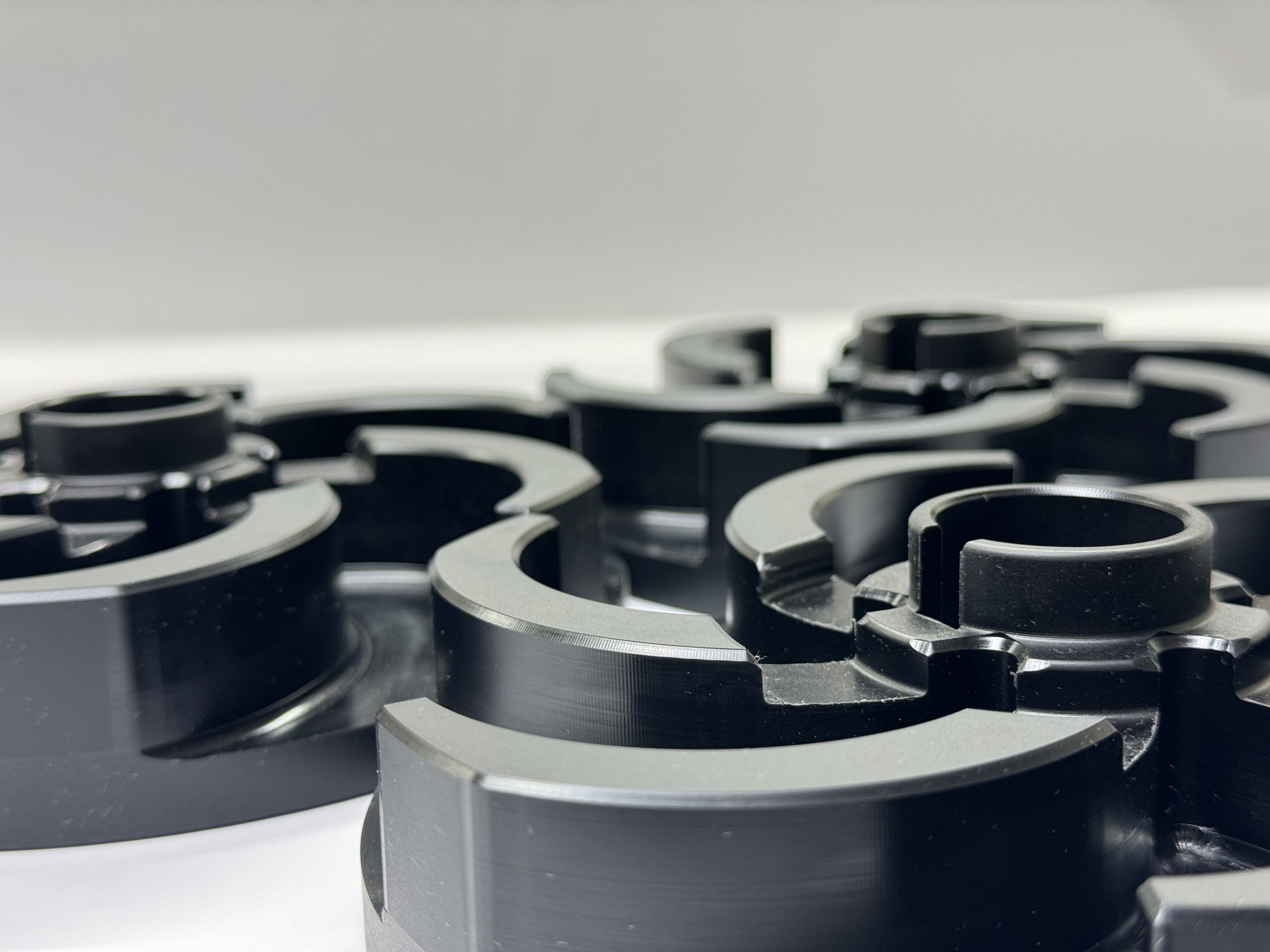
Which plastic materials can be CNC machined?
Most engineering plastics can be machined with conventional CNC machines, but properties vary significantly between materials.
At Scanco, we work with, among other things:
POM-C
A good choice when dimensional stability, precision and good machining properties are important. Typical components are bushings, gears, guides, holders and other precision parts.
PA6
Has high strength, toughness and wear resistance. PA6 is used for wheels, rollers, bushings and machine components that are exposed to mechanical stress, among other things.
PEHD1000
Has very good sliding and wear properties and is often used for slide rails, wear strips, guides and components in transport and process equipment.
PTFE
Has very low friction and high chemical resistance. The material is used for seals, insulating components and parts that work against aggressive media, among other things.
Machining plastics is not the same as machining metal
Although many of the same CNC machines can be used, engineering plastics behave differently than steel and aluminum.
Plastics generally have lower thermal conductivity and stiffness than metal, so heat generated during machining can affect both the material and the dimensions of the component.
Among other things, the following must be taken into account:
- heat generation during cutting
- correct tool geometry and cutting data
- clamping without deformation
- thermal expansion of the material
- voltage level in the semi-finished product
- moisture absorption for certain materials
- necessary tolerances in the finished application
The goal is not necessarily to achieve the smallest possible tolerance, but to produce a component that retains the correct function and dimension under the conditions in which it will actually be used.
Tolerances on CNC machined plastic parts
How tight tolerances are appropriate depends on the material, the geometry and the operating conditions.
For example, POM-C has good dimensional stability and is well suited for components with relatively tight tolerance requirements.
PA6 can absorb moisture from the environment, which can affect dimensions. Consideration must therefore be given when the component is to be used in humid environments or where dimensional requirements are particularly critical.
PEHD1000 is very durable, but significantly softer and more temperature sensitive than POM-C. Very tight tolerances are therefore rarely the main reason for choosing PEHD1000.
In other words, the choice of material should be made based on the function of the component, not just which plastic is easiest to machine.
When should you choose plastic over metal?
Engineering plastics can replace components made of steel, stainless steel or aluminum in many applications.
It may be particularly interesting when you want to:
Lower weight
Plastic components can significantly reduce moving mass and total weight.
Corrosion resistance
Plastic does not rust and can be advantageous in wet or chemically demanding environments.
Low friction
Materials such as PEHD1000, POM-C and PTFE can provide good sliding properties.
Reduced need for lubrication
Certain plastic materials can be used in sliding applications where external lubrication is desired to be reduced or eliminated.
Electrical insulation
Plastic can be a natural choice when the component is not to conduct electrical current.
Lower noise
Gears, guides and other moving components made of plastic can, in some designs, reduce vibration and mechanical noise.
Typical CNC machined components in engineering plastics
Scanco can produce both simple and complex components in technical plastics, for example:
- bushings and plain bearings
- slide rails and wear strips
- rollers and wheels
- gear
- guides
- spacers and insulators
- flanges
- sealing and valve components
- machine parts and spare parts
- prototypes and special components
Production can be based on the customer's drawing or 3D model.
If you only have one existing component, you can 3D scanning and reverse engineering also used as a basis for reconstructing geometry and establishing new production bases.
From semi-finished product to finished component
An advantage at Scanco is that we work with both technical plastic semi-finished products and CNC machining.
This allows material selection and production method to be assessed together.
Instead of the customer first specifying a material and then finding someone who can machine it, we can help assess which plastic quality suits the component's load, environment and function – and then deliver the finished machined part.
This is particularly useful for spare parts, special components and structures where an existing metal component is being considered for replacement with engineering plastic.
POM-C, PA6, PEHD1000 or PTFE?
The choice of material depends on the application.
If you are unsure which material is suitable, we have made a separate comparison of POM-C, PA6, PEHD1000 and PTFE, where the materials are compared with regard to, among other things, strength, friction, wear, moisture and chemical resistance.
CNC machining of plastics at Scanco
Scanco supplies CNC machined components to Norwegian industry from our own workshop in Bergen. We work with technical plastics, composites, steel, stainless steel and other metals, and can supply both individual components, spare parts, prototypes and series.
Do you have a drawing, 3D model or existing component you want manufactured?
Send us an inquiry, then we can consider material, production method and solution.