
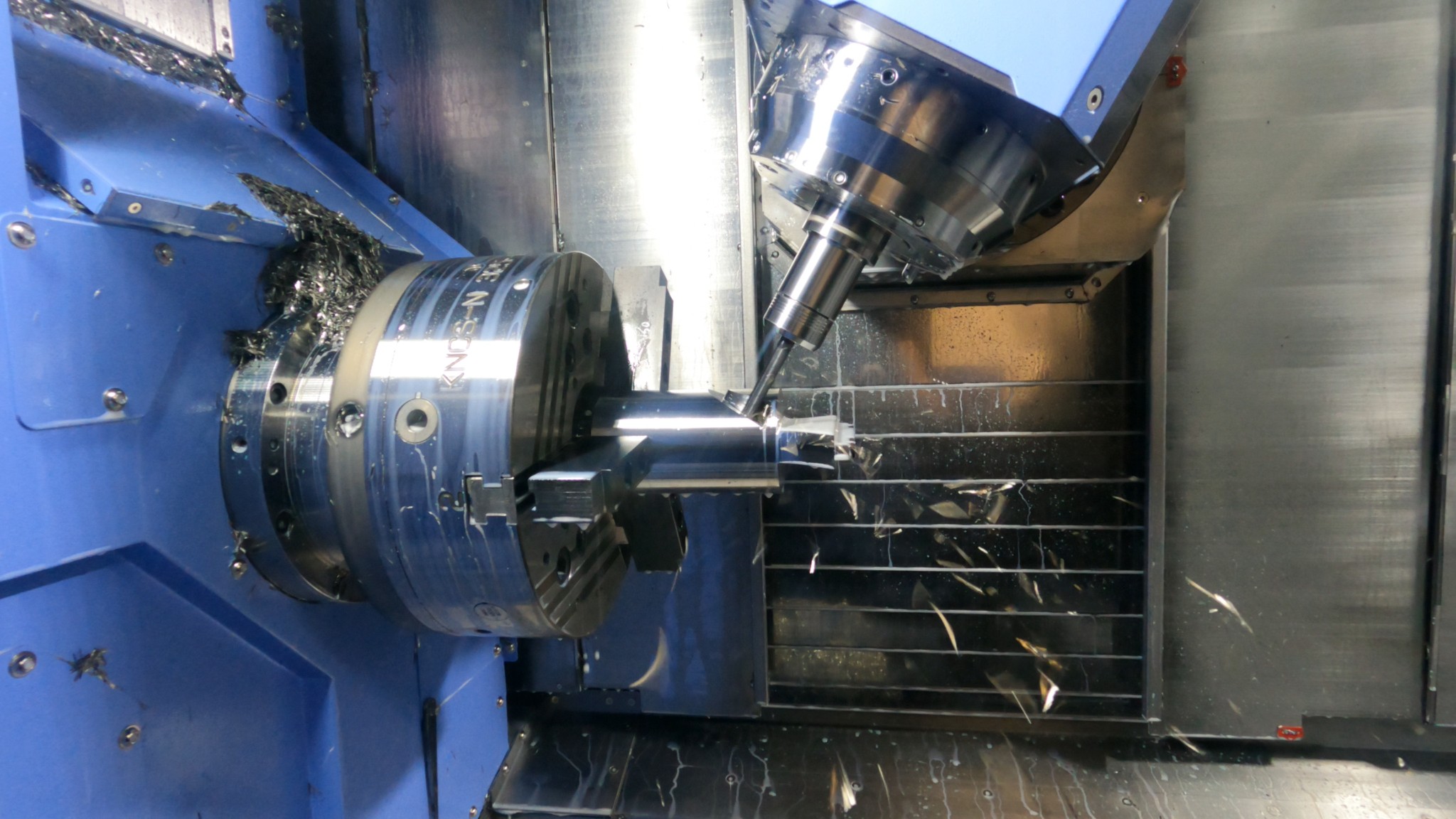
What is the difference between CNC milling and CNC turning?
The fundamental difference between milling and turning is how the movement between the tool and the workpiece takes place.
By CNC milling The workpiece is normally held stationary while a rotating cutting tool processes the material. The method provides great geometric freedom and is used for surfaces, grooves, pockets, holes, contours and complex three-dimensional geometries, among other things.
By CNC turning The workpiece rotates while the cutting tool processes the component. Turning is therefore particularly well suited for components with rotationally symmetrical geometry, such as shafts, bushings, bolts, flanges and other round components.
However, many components require both turning and milling operations. In this case, the operations can either be performed in multiple machines and setups or combined in one mill-turn machine.
When is CNC milling used?
CNC milling is particularly relevant when the component has geometries that cannot be produced by turning alone. Modern CNC milling machines can machine the component along multiple axes and produce both simple and very complex geometries.
Typical milling operations include face milling, contour milling, drilling, threading, slots and pockets. When producing more complex components, several of these operations can be combined in the same setup.
The method is used on a variety of materials. At Scanco, we machine steel, stainless steel, other metals, technical plastic and composite materials.
When is CNC turning used?
CNC turning is usually a natural choice when a significant portion of the component's geometry is cylindrical. The workpiece rotates about its own axis while the tool machines external and internal diameters, end faces, grooves, threads and other details.
Typical turned components are shafts, bushings, sleeves, bolts, flanges and other rotationally symmetrical machine parts.
If the component also requires, for example, holes, surfaces or other details off the center axis, milling operations may be necessary. For such components, combined turning and milling can be particularly effective.
Combined turning and milling with mill-turn
Mill-turn combines turning and milling operations in the same machine, making it possible to produce components that would otherwise require multiple machines and fixtures.
Scanco's machinery includes, among other things, a DN Solutions SMX2100S 5-axis mill-turn, which combines advanced turning and milling operations in the same machine.
The ability to perform multiple operations in the same setup can reduce the need for re-rigging and contribute to good repeatability and precision. This is particularly interesting for complex components that combine turned and milled geometries.
When is 5-axis CNC machining an advantage?
At the 5th axis CNC machining The tool can machine the component from multiple angles without necessarily having to re-clamp the workpiece for each side.
This is especially useful for components with complex geometries, inclined surfaces, holes in multiple directions, or areas that are difficult to reach with traditional 3-axis machining.
Fewer fixtures can also be an advantage when multiple geometric elements have tolerances or positional requirements in relation to each other. At the same time, 5-axis machining is not automatically the best or most cost-effective solution for all components. The production method should be selected based on the actual geometry and requirements of the component.
CNC machining of metal and engineering plastics
The choice of material has a great impact on both the machining method, tool selection and how the component should be produced. Scanco machines components in, among other things, steel, stainless steel, other metals, technical plastic and composite materials.
Within technical plastics, we work with, among other things: POM-C, PA6, PE-HD 1000 (UHMW-PE), PET, PEEK and PTFE. The materials have different properties when it comes to strength, friction, wear resistance, temperature and chemical resistance, and the right choice of material therefore depends on the component's area of application.
Since Scanco both supplies semi-finished products in technical plastics and performs CNC machining, we can deliver everything from plates, bolts and blanks to fully machined components according to drawings or 3D models.
How to choose the right machining method?
The choice between CNC milling, CNC turning, mill-turn and 5-axis machining is primarily determined by the component's geometry and requirements.
A relatively simple, rotationally symmetrical component will often lend itself well to turning, while components with surfaces, slots, holes and other geometries will often require milling. If the component combines both, mill-turn can make it possible to perform multiple operations in the same machine and fixture.
For complex components, 5-axis machining can reduce the number of setups and enable more sides and angles to be machined efficiently. Material, tolerances, number of components and surface requirements are also important factors when determining the manufacturing method.
Therefore, we consider the production method based on the specific component rather than using the same process on all jobs.
From drawing or 3D model to finished component
CNC manufacturing can normally be carried out directly from the customer's drawing and/or 3D model. Using CAD/CAM, toolpaths and production setups are prepared adapted to the component's geometry, material and tolerance requirements.
If the customer has an existing component, but lacks complete production documentation, 3D scanning and reverse engineering also used to establish digital geometry as a basis for further work.
This makes it possible to handle both new components, prototypes, spare parts and components that no longer have available production drawings.
Do you need CNC machining?
Scanco performs CNC machining from our own workshop in Bergen and delivers machined components to industrial customers throughout Norway. We work with both individual components, prototypes, spare parts and series production in metal, technical plastics and composite materials.
If you have a drawing, 3D model or existing component to be manufactured, you can send us the basis for assessment. We can assist with the selection of material and production method and provide a quote for a finished machined component.