
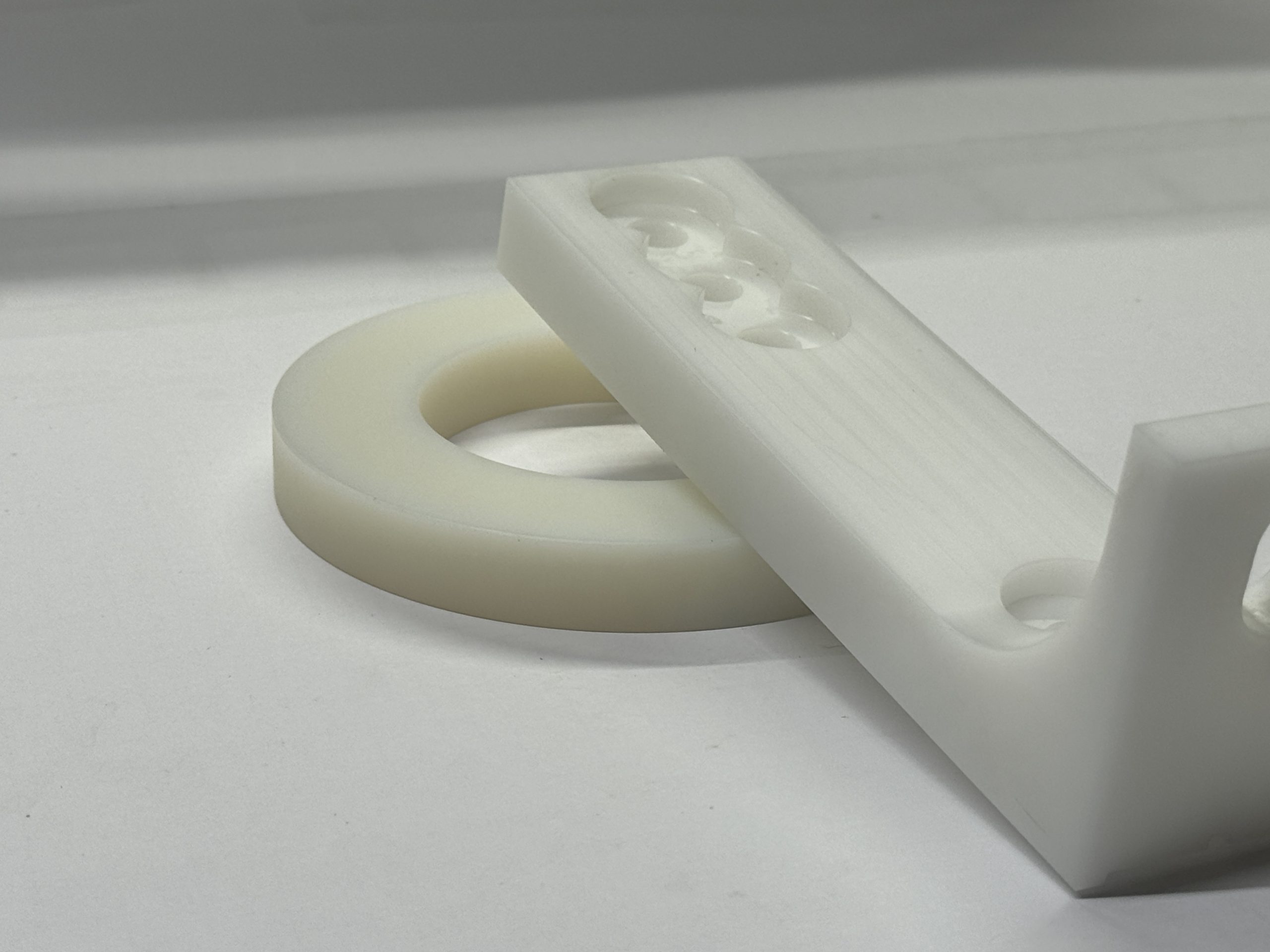
PEHD1000 is a durable engineering plastic with a very high molecular weight, low friction and good resistance to chemicals and moisture. The material is therefore widely used for machine parts, slide rails, wear plates, guides and other components that are subject to wear or movement.
PEHD1000 also referred to as PE1000 and UHMW-PE (UHMWPE). The material is supplied as plates and rods, among other things, and can be machined into finished components according to drawings or 3D models.
But when is PEHD1000 the right choice of materials – and when POM-C or PA6 be better?
What is PEHD1000?
PEHD1000 is a polyethylene with a very high molecular weight. The long molecular structure gives the material high wear resistance and impact resistance compared to many other types of polyethylene.
An important property is the low coefficient of friction. PEHD1000 is therefore often used where components are to slide against each other or where you want to reduce friction against, for example, metal.
The material absorbs very little water and has good resistance to many chemicals, making it interesting in both wet and chemically exposed environments.
Typical applications for PEHD1000
The combination of abrasion resistance, low friction and chemical resistance makes PEHD1000 suitable for a variety of industrial components.
Typical uses include:
- slide rails and guides
- wear plates and wear strips
- chain guides
- conveyor components
- support lists and profiles
- machine parts exposed to impact and wear
- components in wet or corrosive environments
- special parts machined according to drawing
PEHD1000 used especially where low friction and high wear resistance are more important than high stiffness and very small dimensional tolerances.
PEHD1000 compared to POM-C
PEHD1000 and POM-C Both are widely used for machined components, but the materials have different strengths.
PEHD1000 is particularly interesting when the component is exposed to sliding, impact or heavy wear. The material has very low moisture absorption and good sliding properties.
POM-C is stiffer and has better dimensional stability. This makes POM-C better suited to precision components where tolerances, dimensional stability and mechanical rigidity are important.
A sliding rail or wear plate can therefore be well suited for PEHD1000, while a precise machine component with tighter tolerances will often be better suited in POM-C.
PEHD1000 compared to PA6
PA6, often referred to as nylon, has higher stiffness and mechanical strength than PEHD1000 and can be a good choice for, among other things, machine parts, wheels, bushings and other mechanically stressed components.
PEHD1000 has very low moisture absorption and good sliding and wear properties. PA6 absorbs more moisture, which can affect the dimensions and material properties.
The choice of material therefore depends on factors such as load, environment, temperature, wear and dimensional stability requirements.
Machining of PEHD1000
PEHD1000 can CNC machines to finished components by, among other things, milling and turning.
However, the properties of the material mean that the machining must be adapted to the plastic. PEHD1000 is relatively soft and tough compared to, for example, POM-C, and heat generation and clamping must be handled correctly to achieve the desired geometry and surface.
When producing components, one should therefore take into account both the material properties and the tolerances the part actually requires.
Scanco delivers both PEHD1000 as semi-finished products and finished machined components according to drawing or 3D model.
PEHD1000 in wet and chemically exposed environments
One of the advantages of PEHD1000 is the combination of very low water absorption and good chemical resistance.
This makes the material suitable for components used in contact with water, cleaning agents and a variety of industrial chemicals. However, exact chemical resistance should be assessed against the relevant medium, concentration and temperature.
For applications within the food industry, material grades with relevant approvals for contact with food can also be supplied. Documentation and approval requirements should be clarified for the specific application.
When should you choose PEHD1000?
PEHD1000 is particularly interesting when the component is to have low friction, high wear resistance, low water absorption and good resistance to chemicals.
If high stiffness, precise tolerances or higher mechanical strength are more important, other engineering plastics such as POM-C or PA6 be better alternatives.
The right choice of material should therefore be made based on how the component will actually be used – not just based on which material has been used previously.
Not sure which material is right for you? See our comparison of POM-C, PA6, PEHD1000 and PTFE.
Do you need PEHD1000 or a finished machined component?
Scanco supplies technical plastics to Norwegian industry both as semi-finished products and finished components. We can supply PEHD1000 in standard format or produce components according to drawings, measurements or 3D models.
We can also assist with choosing between PEHD1000, POM-C, PA6 and other engineering plastics based on the requirements of the application.