
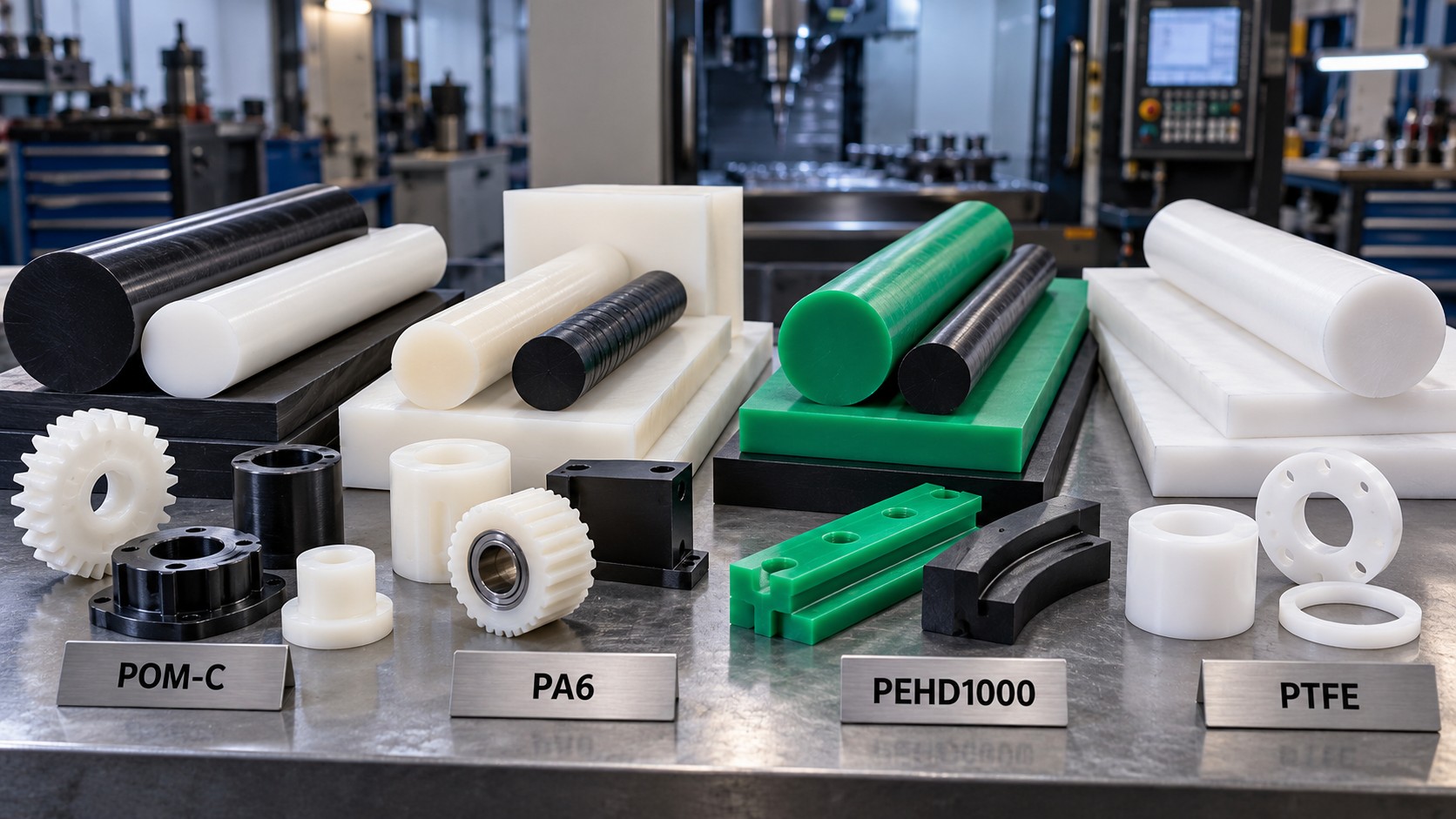
Brief comparison of POM-C, PA6, PEHD1000 and PTFE
| Material | Particularly suitable when you need | Typical components |
|---|---|---|
| POM-C | Dimensional stability, rigidity and precision | Bushings, gears, guides and precision parts |
| PA6 | Strength, toughness and durability | Wheels, rollers, bushings and machine parts |
| PEHD1000 | Abrasion resistance, impact resistance and very low friction | Slide rails, wear strips and guides |
| PTFE | Chemical resistance, temperature resistance and very low friction | Seals, sliding parts, insulators and valve parts |
This is a simplified comparison. The specific application must always be considered before final material selection.
POM-C – when precision and dimensional stability are important
POM-C is a rigid engineering plastic with low moisture absorption, low friction and good dimensional stability.
The material is particularly well suited for machined components where tolerances and stable geometry are important. That is why POM-C is often used for, among other things, bushings, gears, guides and other precision mechanical components.
Compared to PA6, POM-C is less affected by humidity, which can be an important advantage when maintaining component dimensions under varying conditions.
Select POM-C when: Precision, rigidity and dimensional stability are important.
Read more about properties and uses of POM-C plastic.
PA6 – when strength and toughness are prioritized
PA6, also known as polyamide or nylon, is a strong and tough engineering plastic with good mechanical properties.
The material is widely used for mechanically stressed components such as wheels, rollers, bushings and machine parts. PA6 has good wear resistance and can be a good choice when the component is exposed to shock or mechanical stress.
An important difference from POM-C is that PA6 absorbs more moisture. Moisture absorption can affect both dimensions and material properties and must therefore be taken into account for components with strict tolerance requirements.
Choose PA6 when: mechanical strength, toughness and wear resistance are more important than very high dimensional stability.
Read more about properties and uses of PA6 plastic.
PEHD1000 – for sliding, abrasion and impact
PEHD1000, also known as PE1000 or UHMW-PE, differs from POM-C and PA6 through very good sliding and wear properties.
The material has very low water absorption and high impact resistance and is widely used for slide rails, wear strips, guides and other components where low friction and wear resistance are important.
However, PEHD1000 is significantly less rigid than POM-C. It is therefore not normally the first choice for precision components where rigidity and tight tolerances are essential.
Choose PEHD1000 when: Low friction, impact resistance and wear resistance are prioritized.
Read more about properties and applications of PEHD1000.
PTFE – for chemicals, temperature and very low friction
PTFE is known for very low friction, very good chemical resistance and a wide applicable temperature range.
The material is used for seals, linings, sliding parts, electrical insulators and components in process equipment, among other things.
PTFE is also softer and less rigid than, for example, POM-C. This means that PTFE is not automatically the best material just because the friction is low. For mechanically stressed precision components, other materials may be better suited.
Choose PTFE when: chemical resistance, temperature resistance or very low friction are crucial.
Read more about properties and uses of PTFE plastic.
Which engineering plastic is best resistant to water and moisture?
Water and humidity are particularly important when PA6 is compared to the other materials.
PEHD1000 and PTFE have very low water absorption. POM-C also has low moisture absorption and good dimensional stability.
PA6, on the other hand, absorbs moisture to a greater extent. This does not mean that PA6 cannot be used in wet environments, but dimensional changes and altered material properties must be taken into account in the assessment.
For components with tight tolerances in humid environments, POM-C may therefore be more appropriate than PA6, depending on other requirements.
Which plastic is best for sliding parts and wear?
There is no one material that is always best.
PEHD1000 is often interesting for slide rails and wear strips due to the combination of low friction and high wear resistance.
POM-C may be better when the sliding part simultaneously requires higher rigidity and more precise dimensions.
PTFE has very low friction and may be relevant for special requirements regarding chemicals or temperature, while PA6 may be well suited for mechanically stressed wear parts.
Counter material, speed, load, lubrication and temperature also affect material selection.
Which plastic is best to CNC machine?
All four materials can be machined, but they behave differently during processing.
POM-C has good machining properties and is particularly well suited when the component requires high precision and dimensional stability.
PA6 also machines well, but moisture absorption and stress conditions in the material must be taken into account.
PEHD1000 is softer and requires proper clamping and tools to achieve the desired geometry.
PTFE is also relatively soft, and construction, clamping and tolerance requirements must be adapted to the material's properties.
Scanco performs CNC machining of engineering plastics according to drawing or 3D model.
Material selection is about the entire application
It is rarely correct to choose a material based on a single property.
Before determining the material, the following should be considered, among other things:
- mechanical load
- static or dynamic load
- temperature
- water and humidity
- chemicals
- friction and wear
- tolerance requirements
- dimensional stability
- electrical properties
- requirements for approvals
- expected life span
- cost
In some applications, a more expensive material can result in a lower total cost if the component has a longer lifespan or better reliability.
Unsure about which plastic material you need?
Scanco supplies technical plastics as semi-finished products and finished machined components to Norwegian industry.
We can assist with the assessment of POM-C, PA6, PEHD1000, PTFE and other technical plastic materials based on load, environment and requirements for the component.
The component can be delivered as a semi-finished product or fully CNC-machined according to a drawing or 3D model.