
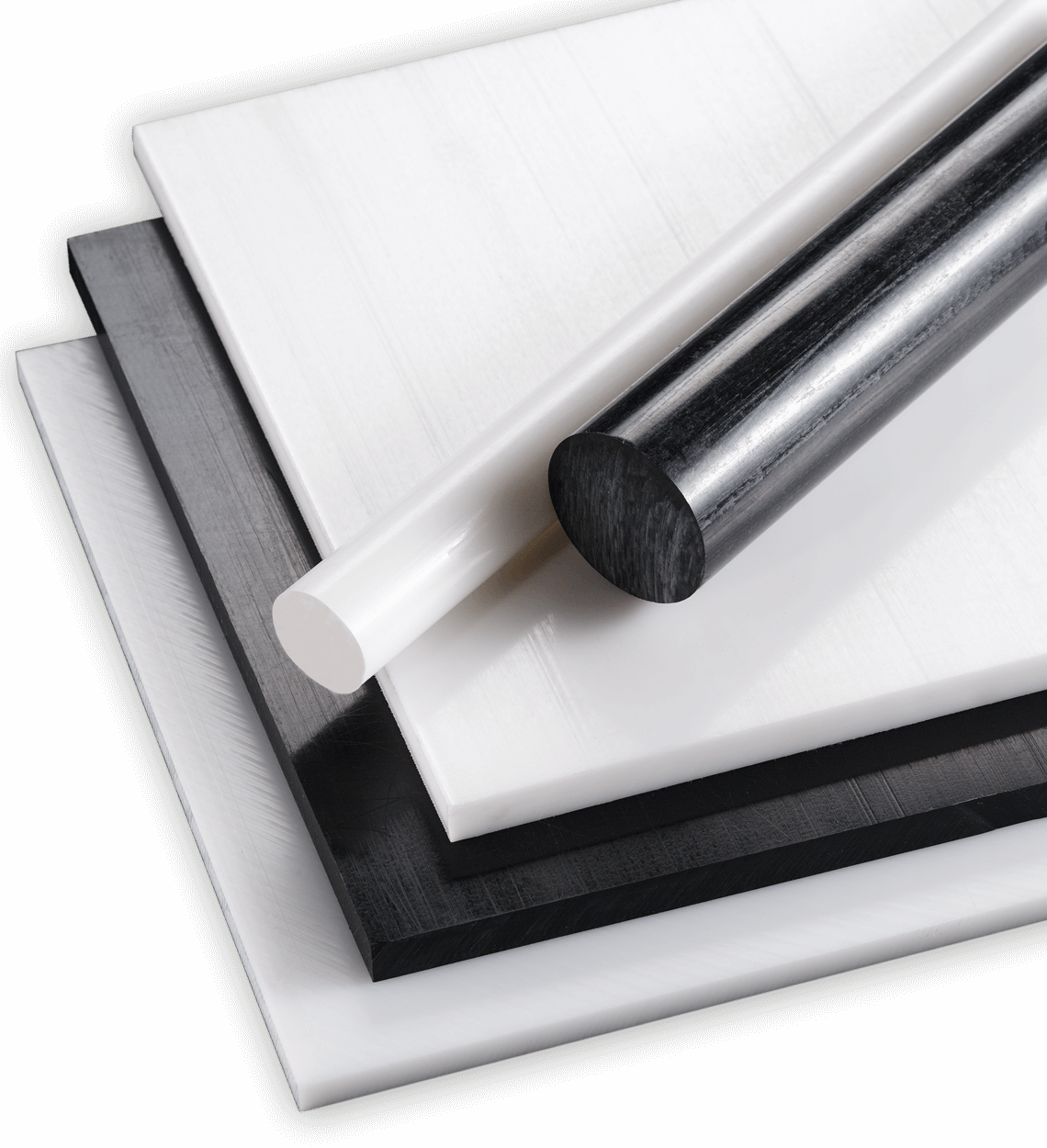
PA6 is one of the most widely used engineering plastics for machined components. The material combines good mechanical strength, wear resistance and toughness, and is therefore used for, among other things, bushings, wheels, rollers, guides and other machine parts.
PA6 also referred to as polyamide 6 or nylon 6, and is delivered as semi-finished products in, among other things, plates, rods and blanks for further machining.
But PA6 also has properties that must be taken into account when choosing materials – especially moisture absorption. In some applications, therefore, POM-C or other technical plastic materials may be a better alternative.
What is PA6?
PA6 is a thermoplastic in the polyamide family. The material has a good combination of mechanical strength, toughness and wear resistance, while its specific weight is significantly lower than that of metals.
This makes PA6 interesting when you want to replace components in, for example, steel, aluminum or other materials with a lighter plastic component.
The material can be machined using conventional CNC processes and is therefore widely used for custom-made industrial components.
Typical applications for PA6
PA6 used in many types of machines and industrial structures where the components are exposed to mechanical stress and wear.
Typical applications are:
- bushings and bearing components
- wheels and rollers
- guides and slide rails
- gear
- machine parts and spacers
- supports and wear parts
- components for conveyors
- special parts machined according to drawing
The material's combination of strength and durability makes it particularly suitable for components that have previously been manufactured in metal, but where lower weight, corrosion resistance or other properties of engineering plastics are desired.
PA6 or POM-C – what's the difference?
PA6 and POM-C are two common engineering plastics, both used for machined industrial components, however, they have different properties.
PA6 has good mechanical strength, toughness and wear resistance and can be a good choice for, among other things, wheels, rollers, bushings and larger machine parts.
POM-C has very good dimensional stability, low moisture absorption and is well suited for precision components where tolerances and dimensional stability are important.
An important difference is that PA6 absorbs moisture from the environment. This can affect both dimensions and mechanical properties. For components with tight tolerances or large variations in humidity, this can POM-C be a better alternative.
The choice should be made based on the specific application rather than considering the materials as direct replacements for each other.
What does moisture absorption in PA6 mean?
Moisture absorption is one of the most important properties to know when PA6 considered as a construction material.
Polyamide absorbs moisture from the environment. When the moisture content changes, the dimensions and some of the mechanical properties of the material can also change.
This may not be a problem in a component where tolerances are wide, but can be crucial in a precision part.
When designing and machining, the environment in which the component will be used should therefore be considered along with the requirements for tolerances and dimensional stability.
PA6 compared to PEHD1000
PA6 and PEHD1000 can both be used for wear parts and machine components, but the properties are quite different.
PA6 generally have higher stiffness and mechanical strength, while PEHD1000 is particularly interesting when very low friction, high wear resistance, impact resistance and very low water absorption are desired.
To a mechanically loaded machine part can PA6 therefore be a natural choice, while PEHD1000 is often interesting for, for example, slide rails, wear strips and guides.
The choice of material depends on factors such as load, temperature, friction, humidity and tolerance requirements.
CNC machining of PA6
PA6 can milled, turned and drilled to finished components according to drawing or 3D model.
As with machining of other engineering plastics, cutting data, tools and clamping must be adapted to the material. Heat generation and deformation during machining must also be taken into account if the component has demanding geometry or tolerances.
Scanco delivers PA6 both as semi-finished and finished machined components for industry.
This makes it possible to deliver everything from plates or bars for the customer's own processing to complete components manufactured according to the customer's production specifications.
When should you choose PA6?
PA6 is particularly relevant when you need an engineering plastic with a good combination of strength, toughness and durability.
The material may be well suited for mechanically stressed components where lower weight and corrosion resistance are desired compared to metal.
If very good dimensional stability and low moisture absorption are essential, POM-C should be considered. If low friction, very low water absorption and good sliding properties are most important, PEHD1000 be more relevant.
There is therefore no single technical plastic material that is best for all applications.
Not sure which material is right for you? See our comparison of POM-C, PA6, PEHD1000 and PTFE.
Do you need PA6 or help with material selection?
Scanco supplies technical plastics to Norwegian industry as both semi-finished and finished products. machined components.
We can deliver PA6 in different dimensions and qualities, machine components according to drawings or 3D models and assist with the choice between PA6, POM-C, PEHD1000 and other technical plastic materials.